Sunday, September 9, 2012

Call for Submissions: American Epitaphs


Grave Marker Macabre: the new feature “American Epitaphs” seeks to collect imagined tombstone inscriptions (written from a pseudo-posthumous viewpoint).  The epitaphs can range from the solemn to the sardonic (think of the oft-cited line found in Key West Cemetery: “I TOLD YOU I WAS SICK”).  I want to be impressed by your creativity and ingenuity, your wit and wordplay.  Reminder: you’re composing the epitaph of an anonymous, fictitious figure (i.e. not your own prospective epitaph or that of any real/historical person).


LENGTH: Your submitted epitaph should not be longer than a tweet (140 characters or less).  Remember the context: space would be limited on the ostensible headstone engraved with this sentiment.  So think of it as writing micro-poetry, and make those words count!


PUBLICATION SCHEDULE: I aim to publish a handful of epitaphs within each American Epigraphs post here at Macabre Republic.  The more quality submissions I receive, the more often the feature will run.  I would love to build up to the point of a regular weekly schedule (comparable to the Sunday offerings at PostSecret).


PAYMENT: Publication and link.  The byline will appear in the form of “—submitted by First and Last Name, from City, State,” with your name serving as a hyperlink to your blog or website.


HOW TO SUBMIT: Email me at minimonkjoe[at]aol[dot]com.  Subject line should read “SUBMISSION: AMERICAN EPITAPHS.”  No cover letter necessary; just place your submission (epitaph and byline) in the body of the email.  Multiple submissions are fine, but a writer can only have one accepted epitaph appear per post.


RESPONSE TIME: An acceptance or rejection email will be sent within one week.  Upon acceptance, I will ask you to provide the URL for your blog/website (you don’t have to worry about including it with your original submission).


To get a better idea of what I am looking for, consider this list of imaginary epitaphs that I have composed:
 

STARVING ARTIST, DEDICATED TO HIS CRAFT


SO LONELY I COULD DIE


AND STILL YOU ARE WALKING ALL OVER ME


TROUBLE THINKING INSIDE THE BOX


UPSKIRT SHOTS: ALL I HAVE TO LOOK FORWARD TO THESE DAYS


THE REGRET METASTASIZED (NO CURE FOR SOUL CANCER)


HEY BUDDY, GOT A LIGHT?


WOULD KILL FOR A MANICURE RIGHT ABOUT NOW


SIMPLE PROCEDURE, MY ASS


HOPING TO HELP BREAK THE WORLD RECORD FOR A ZOMBIE WALK SOMEDAY


OMERTA: I MEANT IT


SHOULD HAVE TRUSTED MY GUT


SOMEBODY UPDATE MY FACEBOOK STATUS


TRIED SO HARD TO GET AHEAD IN LIFE
GOT THIS HEADSTONE IN DEATH


TIL DEATH DO US PART, I PROMISED
NOW GIVE ME SOME SPACE, WOMAN


TO THE CONQUEROR WORM GOES THESE SPOILS


GOT BEHIND THE WHEEL PICKLED, ENDED UP EMBALMED

Friday, September 7, 2012

Countdown: The Top 20 Jack Ketchum Works of Short Fiction--#14


[For the previous entry on the Countdown, click here.]


#14. "The Best"

This short piece (first published in 2000, and subsequently collected in Peaceable Kingdom) is a premiere example of another typical Ketchum tale-type: the hot-blooded narrative of erotic horror.

Thirty-five-year-old Shelia convinces her great-in-the-sack-but-soon-to-be-ex-boyfriend Tommy (who has told her he is leaving her for another woman) to join her for one last bout of break-up sex.  This proves to be no mere farewell frolic, though, but rather the first act in the diabolical scheme of a woman scorned.

Shelia shows up afterwards at the door of Tommy's new flame Janine, feigning amiability.  But the moment Janine lets her guard down, Shelia knocks her cold with a sucker punch.  She then proceeds to choke Janine to death with a belt taken from the woman's bedroom closet.  She tears off the corpse's nightgown and panties, then takes "a few minutes to give the body a good beating, concentrating on the ribs and head."  What at first appears to be gross overkill is only stage-setting for the really "nasty part" to follow.

A Ziploc bag in Shelia's purse holds the semen-filled condom saved from Shelia's earlier coitus with Tommy.  Shelia places it over her latex-gloved index finger, pricks the Trojan's tip with a pin, and goes to work filling Janine with incriminating DNA.  The victim's lifeless womb needs to be lubricated with blood, and it occurs to Shelia that the police are going to think that Tommy engaged in some Dahmer-esque necrophilia.  "The idea made her giggle," and this singularly chilling reaction indicates just how unhinged Shelia has become.

Her sick mission accomplished, Shelia returns home and slips into bed beside the oblivious Tommy.  Feeling his familiar body heat, Shelia can't help but think "for a moment how sad it was, really, that he'd be leaving anyway.  Not where he wanted to go but somewhere."

"The Best" haunts the reader with its realistic horror, as Shelia's fake-rape frame job seems frightfully plausible.  Ketchum's story also casts a dark shadow over the notion of male prowess.  Because as Tommy is about to discover, being the best lover someone ever had can ultimately turn into your own worst nightmare.

Thursday, September 6, 2012

Hangmany


[For the previous game of Hangmany, click here.]

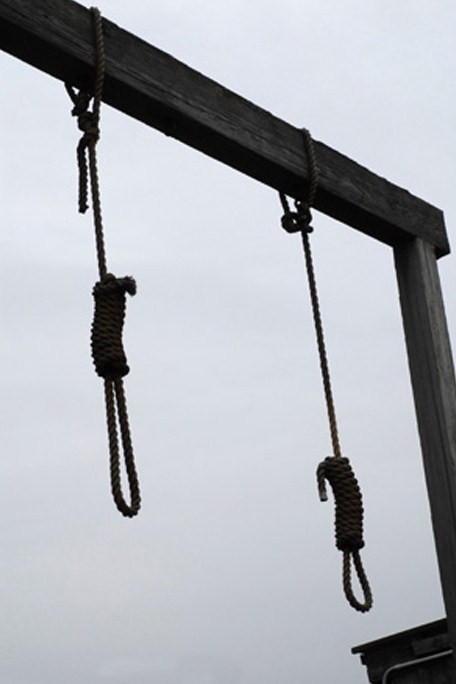
Can you solve the following puzzle within 20 seconds, or are you going to choke?


CATEGORY: SONG TITLE & ARTIST

__  H  __          __  __  __  I  __          __  __  N  __


__  __  __  N          __  __          __  __  __  R  __  I  __


__  Y


__  H  __          __  H  __  R  __  I  __


__  __  N  I  __  __  __          __  __  N  __


MISSES: F, K, M, P, U


HINT: I told you once, you $%&^!...


Correct answer appears in the Comments section of this post.

Tuesday, September 4, 2012

Michael Clarke Duncan, R.I.P.

Sadly, the actor passed away yesterday at the age of 54.  His cinematic immortality, though, had already been assured by his unforgettable turn as John Coffey in The Green Mile.


Monday, September 3, 2012

Countdown--The Top 20 Jack Ketchum Works of Short Fiction--#15


[For the previous entry on the Countdown, click here.]


#15. "Returns"

This 2002 piece (collected in Closing Time and Other Stories) reveals yet another side to the multifaceted Jack Ketchum: the animal lover.  The story's anonymous protagonist comes back from the beyond (four days after being mowed down by a New York City cab driver), "knowing there was something I had to do or try to do."  Upon returning to his apartment, though, he finds that his alcoholic wife Jill has been neglecting Zoey, his beloved cat.  Thinking that perhaps the purpose of his visitation is to help snap Jill out of her drunken funk, the narrator tries to rouse her to attend to Zoey (unlike the cat, Jill can't see her late husband's spectral self, but hears him inside her head).  And fails miserably.

That's largely because Jill already has different plans for Zoey.  The plurality of the story's title comes into play when a stranger bearing a cat-carrier rings the doorbell.  He is reluctant to carry out the deed he's been summoned for, telling Jill that the cat could be put up for adoption for a while rather than being sent straight to death by euthanasia. Cold and malicious, Jill lies that Zoey is a biter and a fighter, and thus unfit for domestic existence.

Jill's callous act is the ultimate betrayal for the narrator, who rages at the miserable widow with ghostly vitriol:
My wife continues to drink and for the next three hours or so I do nothing but scream at her, tear at her.  Oh, she can hear me, all right.  I'm putting her through every torment I can muster, reminding her of every evil she's ever done to me or anybody, reminding her over and over what she's done today and I think, so this is my purpose, this is why I'm back, the reason I'm here is to get this bitch to end herself, end her miserable fucking life and I think of my cat and how Jill never really cared for her, cared for her wine-stained furniture more than my cat and I urge her toward the scissors, I urge her toward the window and the seven-story drop, urge her toward the knives in the kitchen and she's crying, she's screaming, too bad the neighbors are all at work, they'd at least have her arrested.  And she's hardly able to walk or even stand and I think, heart attack maybe, maybe stroke and I stalk my wife and urge her to die, die until it's almost one o'clock and something begins to happen.
What's happening is that the narrator's "power" is fading, in tandem with the waning moments of Zoey's life.  Sensing his cat's death somewhere across the city, the narrator realizes the real purpose of his visitation.  Not to rescue Jill, or even torment her, but to have been there for Zoey one last time before she was carried off: "That last touch of comfort [given to her] inside the cage.  The nuzzle and purr.  Reminding us both of all those nights she'd comforted me and I her.  The fragile brush of souls."

Understanding delivers closure, both to the narrator and the narrative.  Announcing that the "last and best of me's gone now," the devoted pet owner promptly fades from consciousness.  The same cannot be said for this quietly haunting tale (based, the author shares in the appended story note, on his own experience of having to put down his housecat).  Short and bittersweet, "Returns" lingers long past its natural end point.